
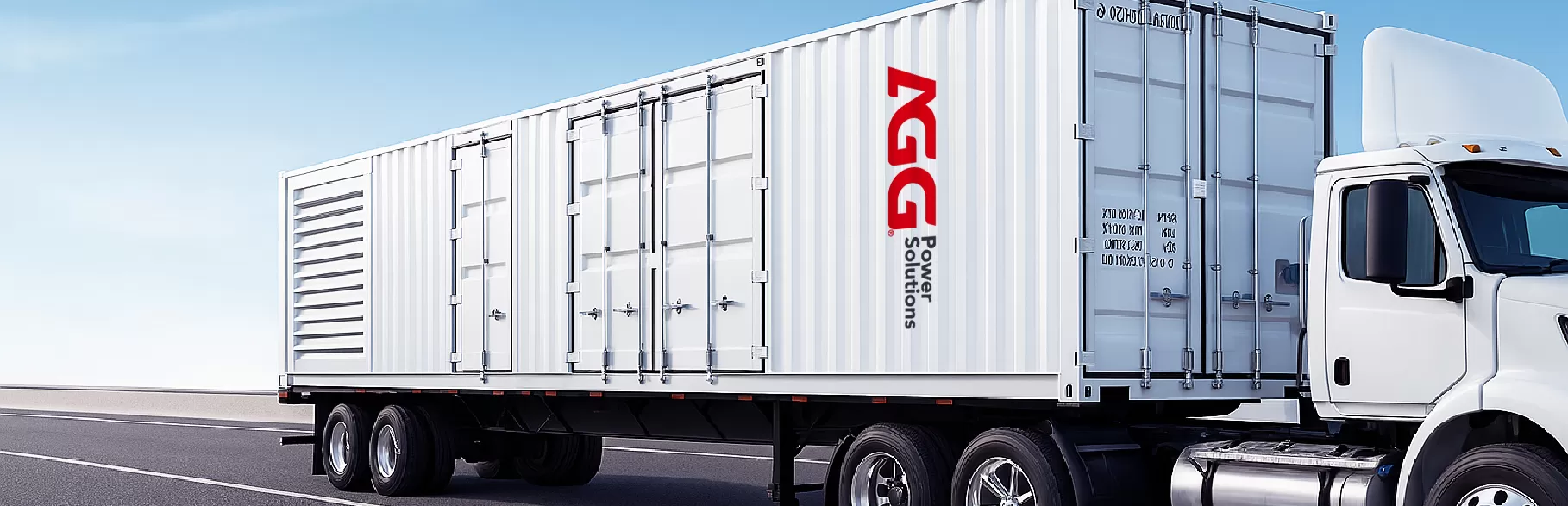
A 3 phase electric generator is the default choice for industrial loads because it delivers power more efficiently than a single-phase unit. Three conductors carry the load with a 120-degree phase shift, which gives a smoother output and a smaller alternator for the same kW.
The buying decision is not just “how many kVA?” The voltage, frequency, prime or standby rating, alternator response, fuel system, enclosure, and load profile all change the answer. AGG Power builds diesel and gas generator sets from 10 to 4,375 kVA. If you are sizing a unit for a plant, send the load list and site conditions to our team before you compare models.
What a 3 Phase Electric Generator Actually Delivers
A three-phase generator produces three alternating voltages with a fixed phase angle. In a 400/230 V system, the line-to-line voltage is 400 V and the line-to-neutral voltage is 230 V. That gives both three-phase loads and single-phase loads from one machine.
The relationship between kVA and kW is the power factor. AGG lists 0.8 lagging for the models below, so 1000 kVA corresponds to 800 kW. If the load has a lower power factor, the generator may run out of current before it reaches its kW rating.
Three-phase power also matters for motors. A three-phase motor has a rotating field, so it starts and runs more smoothly than a single-phase motor of the same rating. That is why pumps, compressors, conveyors, and machine tools are usually three-phase loads.
1. Power Rating: Standby, Prime, or Continuous
Generator ratings are not interchangeable. A standby rating is for emergency use with a limited number of hours. A prime rating is for continuous operation with a variable load. A continuous rating is for a steady load at a fixed power.
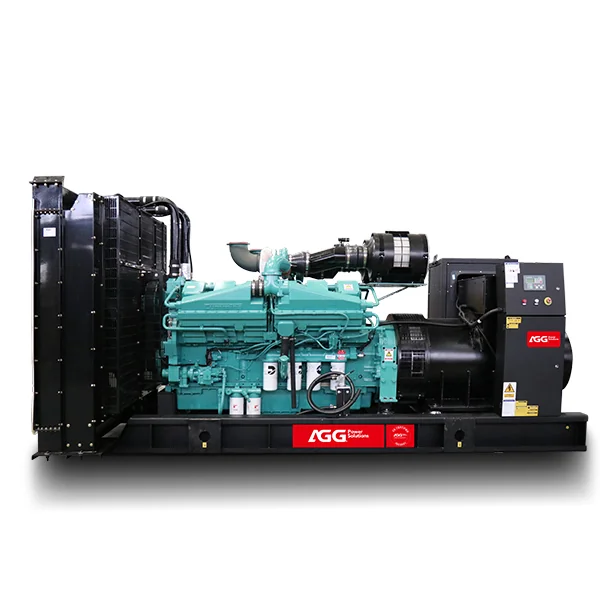
AGG lists both ESP and PRP for its models. The CU1000E5 is 1000 kVA / 800 kW standby and 900 kVA / 720 kW prime. The CU825D5 is 825 kVA / 660 kW standby and 750 kVA / 600 kW prime. Do not size a prime application from the standby number.
Check the site derating too. High ambient temperature, altitude, and enclosure restrictions reduce the usable rating. A unit rated at 40°C may need a larger alternator at 50°C.
2. Voltage and Frequency
Match the generator to the site, not to the catalogue default. A 50 Hz market typically uses 400/230 V or 415/240 V. A 60 Hz market may use 208/120 V, 240/120 V, or 480/277 V.
AGG lists 400/230 V as standard for the CU1000E5 and CU825D5, with 380/220 V and 415/240 V available. Confirm the motor nameplate, the transformer, and the existing switchgear before you lock the voltage.
If the site has both 50 Hz and 60 Hz equipment, do not assume a reconnectable generator solves everything. Frequency affects motor speed, transformer performance, and control electronics. Match the frequency to the load.
3. Alternator and Voltage Regulation
The alternator converts engine power into electrical power. Ask for the insulation class, temperature rise, voltage regulation, and transient response. A brushless alternator with an automatic voltage regulator (AVR) is common for industrial sets.
Transient response matters when a large motor starts. The voltage dip should recover quickly without tripping contactors or drives. Ask for the motor-starting capability at the actual voltage and power factor.
For nonlinear loads such as variable-frequency drives, rectifiers, and data-center equipment, ask for the alternator’s harmonic performance. A generator that is fine on a resistive load can overheat on a harmonic-rich load.
4. Engine, Fuel, and Consumption
The engine sets the fuel type, the speed, and the maintenance interval. Most industrial units run at 1500 rpm for 50 Hz or 1800 rpm for 60 Hz. AGG’s range includes Cummins, Perkins, Baudouin, MTU, Weichai, Deutz, Hyundai, Scania, Mitsubishi, and Volvo engines.
The CU1000E5 uses a Cummins QST30-G3, 12-cylinder, 30 L engine. The CU825D5 uses a KTA38-G2, 12-cylinder, 38 L engine. Both are 50 Hz, 1500 rpm units with electronic engine control.
Ask for fuel consumption at 25%, 50%, 75%, and 100% load. A generator that runs at low load for long periods can wet-stack and dilute the oil. Size the unit so the normal load sits in a healthy band, not at 10% of rating.
5. Enclosure, Cooling, and Noise
An open set needs a plant room with airflow, exhaust routing, and noise control. A silent canopy includes the enclosure, the acoustic lining, and the fuel tank. AGG lists open and silent dimensions for both models, with 1000 L and 1300 L tanks on the silent versions.
Check the ambient rating, the radiator airflow, and the clearance around the enclosure. A canopy that is installed against a wall can recirculate hot air and derate the set. The foundation and the exhaust outlet matter as much as the canopy.
For outdoor sites, confirm the IP rating, the corrosion protection, and the fuel fill access. For rental or mobile use, check the lifting points, the trailer, and the cable connections.
6. Controls, ATS, and Paralleling
The controller should manage start/stop, alarm history, remote monitoring, and the automatic transfer switch (ATS). For critical sites, the ATS sequence and the generator start time decide whether the load rides through the outage.
If the site needs multiple generators, ask for paralleling controls, load sharing, and load shedding. A single large set and two smaller sets can have different redundancy and fuel profiles. The control architecture should match the operating plan.
NFPA 110 is a common reference for emergency and standby power systems in the United States. If the generator supports life safety, confirm the class, the fuel duration, and the maintenance requirements with the authority having jurisdiction.
7. Load Profile and Site Conditions
The load list is the foundation of the sizing. List every load in kW, power factor, starting method, and daily hours. Separate the continuous loads from the intermittent and standby loads.
Motor loads need special attention. A direct-on-line motor can draw several times its running current at start. The generator, the alternator, and the ATS all see that surge. If the site has several motors, ask for a load-step analysis, not a simple kW sum.
Single-phase loads should be balanced across the three phases. A heavy single-phase load on one phase can unbalance the voltage and limit the usable capacity. If the site is mostly single-phase, a three-phase generator can still work, but the phase balance has to be designed.
| Model | Standby ESP | Prime PRP | Voltage / Engine |
|---|---|---|---|
| CU1000E5 | 1000 kVA / 800 kW | 900 kVA / 720 kW | 400/230 V · Cummins QST30-G3 |
| CU825D5 | 825 kVA / 660 kW | 750 kVA / 600 kW | 400/230 V · Cummins KTA38-G2 |
An AGG Power Example
The company produces diesel and gas generator sets from 10 to 4,375 kVA, with solutions for industrial, healthcare, oil and gas, data center, events, defense, and telecom applications. The company reports 80+ countries, 75,000+ generator sets delivered, and 300+ dealer locations.
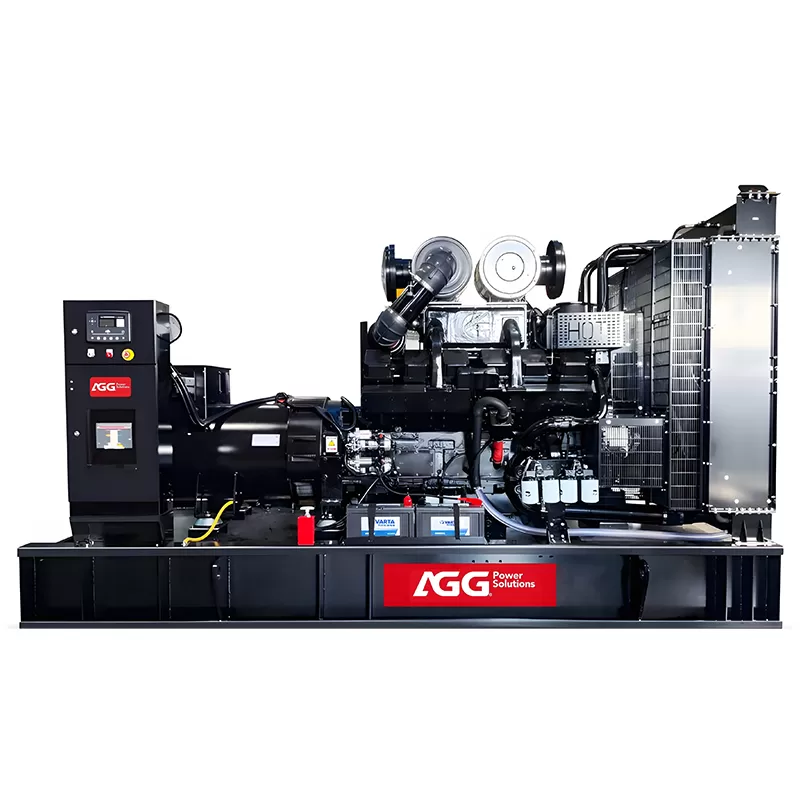
The CU1000E5 and CU825D5 are 50 Hz, three-phase, 0.8 power factor units with 400/230 V standard output and 380/220 V or 415/240 V available. Both use Cummins engines and electronic control. The silent versions include 1000 L and 1300 L fuel tanks.
Those details matter for a plant room: the fuel tank, the enclosure, and the engine control all affect the installation, not just the kVA. Ask for the full drawing and the fuel consumption table before you approve the layout.
Common Mistakes
- Comparing kVA without kW: power factor changes the usable kW.
- Sizing from the standby rating: a prime load needs the prime rating.
- Adding motor kW without starting current: the surge can trip the set.
- Ignoring single-phase balance: one heavy phase limits the whole machine.
- Forgetting derating: heat, altitude, and enclosure reduce output.
- No fuel plan: the tank size and refill schedule decide runtime.
The Load List
Before you request a quote, build a load list with four columns: running kW, starting kVA, power factor, and daily hours. Add the load type and the starting method.
- List every load: motors, drives, lighting, HVAC, IT, and single-phase outlets.
- Mark the starting method: direct-on-line, star-delta, soft starter, or VFD.
- Add the largest motor surge: size the generator for the worst starting event, not the total running kW.
- Apply the site derating: ambient, altitude, and enclosure.
The load list turns a vague “we need a 500 kVA” into a defensible specification. It also shows whether a smaller set with good load management can do the job.
Send the team the load list, voltage, frequency, site conditions, fuel preference, enclosure type, and required runtime. The team can match the generator rating and the control configuration to the project.
Use the AGG Power contact page or email the address listed on the site. For the models, see the CU1000E5 page and the CU825D5 page.
Frequently Asked Questions
Q1: What is a 3 phase electric generator?
A1: It is a generator that produces three alternating voltages with a 120-degree phase shift. It supplies three-phase motors and equipment, and it can also supply single-phase loads through line-to-neutral connections when the phases are balanced.
Q2: What is the difference between kVA and kW?
A2: kVA is apparent power; kW is real power. The ratio is the power factor. At 0.8 power factor, 1000 kVA equals 800 kW. A load with a lower power factor needs a larger generator for the same kW.
Q3: Should I choose 50 Hz or 60 Hz?
A3: Match the frequency to the equipment and the local grid. A 50 Hz motor runs at a different speed on 60 Hz, and transformers and controls may not be compatible. Do not change frequency without reviewing the whole system.
Q4: Can a three-phase generator run single-phase loads?
A4: Yes, through line-to-neutral connections, but the load should be balanced across the three phases. A heavy single-phase load on one phase can unbalance the voltage and reduce the usable capacity.
Q5: What size generator do I need for motor starting?
A5: Size for the largest starting event, not only the running kW. A direct-on-line motor can draw several times its running current. Provide the motor kW, starting method, and sequence so the supplier can check the voltage dip and the alternator capability.
Sources
- ISO 8528-1, reciprocating internal combustion engine driven generating sets — application, ratings, and performance.
- IEC 60034-1, rotating electrical machines — rating and performance.
- NFPA 110, standard for emergency and standby power systems.